Transgender Women
Cultural Chameleons
In this series I surface current cultural arguments around various controversial topics and how they miss the mark by a consistent Biblical standard. While these arguments may help move in the right direction they can be challenged or subverted by pointing out their lack of grounding in ultimate truth.
Sex and gender are not the same
Sex is defined by biological markers (chromosomes, sex organs) and gender is defined by societal norms. What is the significance of the separation in terms of application? Often the answer is in the ability to change one’s gender but not one’s sex. The argument goes that XX chromosomes don’t dictate a societal role of, lets say, nurturing. Typically this starts as much more superficial in the presentation as a gender not in behavioral characteristics. I’m a man and I feel like a woman -> I’m going to dress like a woman -> I’m going to act like what I think a woman acts like -> I’m going to change some of my physical sex characteristics because those are seen as an outward gender expression. Of course chromosomes are not outwardly socially expressed and thus do not need to be “changed”. We’ll walk through each of the steps in this process below.
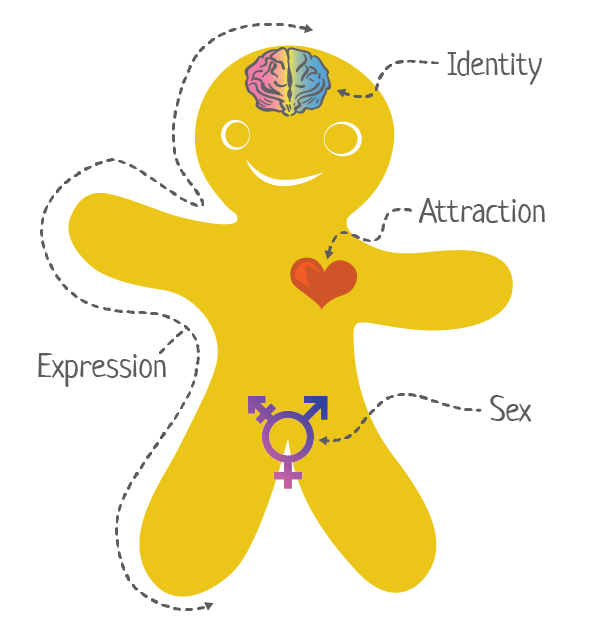
Gender identity
The first step is to sense, feel, and declare how much man-ness or woman-ness you have. The APA refers to this as “a person’s internal sense of being male, female or something else.”
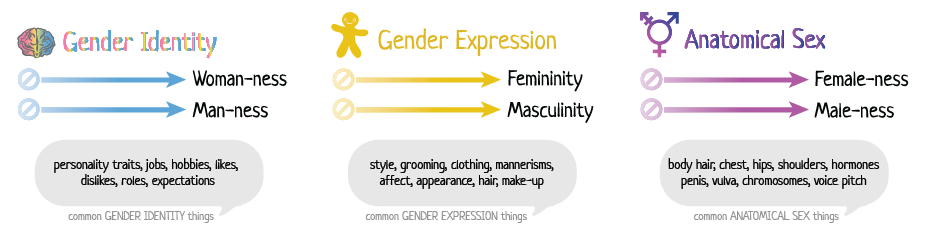
Identity mapping
This is based on your perception of society and how it has defined men’s and women’s roles. You could say that this is mapping your internal preferences to inputs from the world. The world says men like trucks, I like trucks; therefore I must be more man. It accepts the dominant societal definition and maps their preferences onto it. A person’s gender identity is determined by the prominent society that a person lives. If a person with XX chromosomes was trying to map their gender identity to the highland culture of pre-18th century Scotland, and had a preference for bright plaid kilts, they may feel more “like a man.” While culture is an input to a person’s determination of gender identity it remains solely based on their feelings or preferences.
“One is not born, but becomes a woman.” - Simone de Beauvoir, The Second Sex
Can any or all aspects of identity be self determined? Personal preferences exist and if that is what determines identity, it is not untethered from societal experiences. In that case it is stating that “who I am” is the sum of my preferences. And when those preferences are grouped in a certain way they mean either man or woman. Or perhaps I get to map those preferences to a third gender or to an animal. I get to make that decision to map those preferences however I wish and make a determination about my gender. I am the arbiter of my identity.
Born this way
What may be even a more prominent idea is that someone can actually ground this feeling outside of any cultural experiences. You are a woman if you feel like you are a woman, even if it has no tethering to your physical body, expression or culture. I just know I’m a woman. This is also why some believe that babies or children who have very little exposure to gendered norms, can feel they are the wrong gender. This would be a similar argument to how someone can be born gay. They are gay prior to any recognition of or interaction with sex or gender.
The view that we are just born as more female or male, leans on not my own determination of preference mapping but determinism. Something made me a man, a woman, gay, a cat. So what makes someone one way or another from birth? Is it biological determinism and the right condition of cells coming together in the womb? Was someone’s brain built with just the right conditions to make them believe these things and act the way they do? The same process that evolved single-cell bacteria into human beings also can evolve the brain chemistry of a man to “be a woman.”
Liberty chameleons
Those focused on personal liberty may grant that everyone is free to identify however they’d like but only object when expression interferes with someone else’s liberty. Relying on American liberty and grounding moral oughts on the Constitution can only goes as far as political expression and makes no claims on what is morally right within a persons thoughts. While this distinction can be appropriate to limit civil government’s role in personal thought lives, it is not definitional of what is an ultimate right.
You can believe that the government should stay out of our heads and our bedroom and still disagree that identity is mutable and contingent on something other than truth. There is again an analogous relationship between gender identity and homosexual identity. The concept of Side B Christianity grants that people can identify as gay and only condemns acting out that identity in harmony with Christian tradition. This affirmation concludes that there is no moral issue with defining your own identity separate from objective truth. This is not a consistent Christian view of identity.
Essential identity
When we are attempting to define “identity” we are looking at “who we are.” This has taken different shapes formally through history. Some key questions however are exactly what we have been exploring. Is identity received, chosen, or negotiated? If it is received, from where? Prior to the past century many have seen identity as essentially linked to purpose and received. Christian tradition says identity is received from God, even before we are born (Gen. 5.2). Aristotle’s defines “the essence of each thing is what it is said to be intrinsically” (Metaphysics, Book Z). We are who we are absent our feelings about how it maps onto societal roles or what we believe about the physiology of our brain or cells. These more modern concepts of identity are shaped around a subjective individualistic drive. Even in the half-hearted pushback from libertarians, they believe that everyone can have their own opinion and that they are valid. Truth cannot be found. This is not the case, God has defined who we are from the beginning in respect to our gender identity and it maps 1:1 with the physical, biological characteristics that we observe from birth.
Gender expression
This could be seen as the personal output of gender. After defining for myself the level of male or female I feel I am, I can now primarily dress and act the part. This is reflecting back to the world what was input from the world initially. Whatever I determined man and woman to be is now applied to myself to conform to my outward expression to match. If I, in my own interpretation (input), have determined certain characteristics to be associated with woman, not based on anything objective, but on personal observation of majority culture, and I’ve determined that my identity is a woman, by the criteria above, I will start to apply those characteristics to myself and express those characteristics externally to the world in which I’ve observed.
Gender expression can be most visibly seen starting with exaggerated gender observations. A deep understanding of woman-ness is not readily available from cursory pan of culture. The inherently performative nature of expression aims it’s sights on the first exaggerated characteristics it sees and attributes to woman. This is why superficial traits such as wearing makeup or the clothes they wear are the first things that are expressed. Often this hyper focus on gender, also amplifies the importance of sexual expression. This leads to a focus on transforming the body and targeting the distinctive sexual organs as an expression of gender. Those that focus on becoming trans-women then agree with many of their detractors, and against the difference between sex and gender, and start to attribute the very outward sexual organs as an expression of gender. A penis becomes an expression of gender.
This then also translates into participation in group social expressions of gender. Those transitioning to a gender expression of woman seek to be affirmed in that they then can participate in spaces that have been designated as only for women. This includes restrooms, locker rooms and sports. The physiological sex characteristics that forced women’s sports to be created distinct from men’s sports is disregarded in the mind of someone who retains the physical advantages of a man’s biology but wants to be socially affirmed as a woman.
Conservative or Red Pill Chameleon
Gender expression starts with the idea that someone can chose to be something that they are not (gender identity). Expression is just the next step in a misunderstanding of a true identity that is given from creation. If you only recognize the conservative political leanings, either fiscal or even some social beliefs, then you are left without a foundation of Christian identity and may think you still can play as a transgender woman (Blaire White, Caitlyn Jenner). They are ungrounded in Biblical values and contradict themselves by believing that they can be something they are not. This also is applicable for “red pill” men that focus on sexually degenerate behaviors while trying to sleep with as many women as possible. This view also approves of a “conservative” pinup calendar featuring women revealing their bodies for men that are not their husband because they believe in smaller government. The Bible is not an ala carte menu to pick and choose what is true from what God says. You cannot reject what He has made you and then ground your beliefs in sand. A set of beliefs around sex and gender are sourced from the same book that provides us with morality that claims all of the moral stances that are typically associated with a conservative politic.
What is a woman?
If a woman is someone who embodies the cultural and sociological aspects of what an individual observes as being a woman, then this question of “what is a woman” becomes circular. We need to go to a more objective source of truth for what makes a man and a woman if we are then going to express that in the culture. A clear understanding of the inputs to the definitional man and woman are required to then output the expression of those “genders” in society. While there may be some variation in history of what expression is representative of the Biblical virtues of man and woman, that source is still the transcendent aim. You are otherwise failing about in the sea of subjective whims and observations in a shifting society that is unsure of what makes a man and a woman. Distortions occur that skew what we see of a man and woman and we also believe that sexualizing woman is somehow their true calling and not to transition to men. Both are false. Conservative pin-up posters are still distractions from true womanhood. It remains true that expression is based on inputs but not from secular culture but from how God defines a man and a woman in scripture. Texts referring to what it is to be a husband and a wife, a father and mother help to define what behaviors and attitudes are becoming of a man and woman.
Attraction
Attraction takes these subjectively defined characteristics and tries to form a bond between two people. Because it is acceptable to have men attracted to men and women attracted to women, these pairs do not even need to be of opposite sex or gender. Someone born with male sex characteristics who believes their identity to be a woman and expresses themselves that way can be attracted to either another person born with either male or female sex characteristics that may or may not believe their identity and expression match their gender assigned at birth. There are no rules. Attraction is also subjective.

The way the coupling is even labeled indicates perhaps what is the intended telos. Attraction, either sexually or romantically, is the goal. When attraction is the ultimate end then of course it will be subjective. Every individual has preferences and these can then be expressed in “I like that.” But simply, “I like that,” is perhaps only an end goal when there is nothing else larger to point to. When the guiding worldview is primarily utilitarian then the greatest good will always be in the eyes of the subjective individual.
Chameleon’s Ends
When conservatives also don’t share an ultimate end for coupling (or as history would label it, marriage), then they too fall back to a subjective attraction. There are conservatives too that think that marriage’s goal is to love someone. That it is about just being happy. And perhaps some legal and tax benefits. The acceptance of gay coupling by conservative individuals, as long as it doesn’t diminish marriage, is just as misguided. You also can’t just be as surface as saying, marriage is about making kids. You get all the arguments like, “what about couples that can’t have kids?” Is someone who is infertile just as wrong about getting married as those that are attracted to the same gender? The fruits of marriage, whether those be children or otherwise, are a gift, not a guarantee. It does not follow then that because one of the fruits looks impossible that the goal of a marriage has been thwarted. If you say that marriage is only about being happy or about making kids, you are not aiming high enough.
Ultimate goals
Just as if you say marriage is about being happy or the greatest happiness for the most people, you also can say that about all of life. You not only run into the subjective definition of happiness, either individual or collectively, but happiness while we travel through less than a century of life seems fairly meaningless. Why are we here ultimately and what does that have to do with our identity, our expression and who we travel life with? The creator of the world and the one who brought each of us about gives us a guide for how to live life and what an ultimate goal should be. The Bible outlines how God created everything (and it was very good), how humans rebelled against Him by trying to identify as God, and how He was gracious and paid back the price we could not pay. We owe everything to God whether we believe in him or not. He breathed life into our unique perfectly-made selves (not as we imagine but as we actually are), sustains us everyday, and wants for us to recognize Him as our creator and acknowledge our need.
Read MoreCommerce Clause
Summary
The Commerce Clause has gone through major mutations over the course of the country’s history resulting in a variety of cases giving and take powers from the federal government over the centuries.
The Commerce Clause
“The Congress shall have Power To regulate Commerce with foreign Nations, and among the several States, and with the Indian Tribes;” Article 1, Section 8, Clause 3 of the U.S. Constitution
One of the most litigated pieces of the Constitution, the Commerce Clause has been a linchpin for much subsequent legislation. The interpretation of the Commerce Clause has opened the door to government reaching into business dealings even down to individuals and what they do with their own property. Why did the founders originally write this clause and what did they have in mind?
State Infighting
As an assembly of independent colonies, each had their own ideas of what was best for them and their people. While this general principle allows for each state to make adjustments for their locality, there was a threat to the nation as a whole, if there was to be a nation. George Washington noted such a threat when he wrote to Benjamin Harrison and said that “the disinclination of the individual States to yield competent powers to Congress for the Federal Government—their unreasonable jealousy of that body & of one another—& the disposition which seems to pervade each, of being all-wise & all-powerful within itself, will, if there is not a change in the system, be our downfall as a Nation.”
“The king of New York levied imposts upon New Jersey and Connecticut, and the nobles of Virginia bore with impatience their tributary dependence upon Baltimore and Philadelphia. Our discontents were fermenting into civil war.” – Fisher Ames
If we attempt to look at the Biblical backing for intentionality here we can most likely find the principle of equal weights and measures (Lev. 19:35-36, Prov. 11:1). Just like separate nations, states could look out for their own interests and put taxes and penalties on goods and services crossing state lines. This, for instance, put’s the thumb on the scale of a contract between someone in New York and someone in New Jersey as opposed to the equal contract of two parties in a single state.
International Trade
The state infighting was not only threatening between the states but also beyond the borders of the disunified states. Other nations were finding it difficult to trade with all the individual states and were reticent to do so.
Hamilton in Federalist 22 spoke of the German empire’s difficulty with the states. “The interfering and unneighborly regulations of some States, contrary to the true spirit of the Union, have, in different instances, given just cause of umbrage and complaint to others, and it is to be feared that examples of this nature, if not restrained by a national control, would be multiplied and extended till they became not less serious sources of animosity and discord than injurious impediments to the intercourse between the different parts of the Confederacy. ‘The commerce of the German empire is in continual trammels from the multiplicity of the duties which the several princes and states exact upon the merchandises passing through their territories, by means of which the fine streams and navigable rivers with which Germany is so happily watered are rendered almost useless.’”
In the 1888 case, Kidd v. Pearson, Justice Lamar in the decision of the court reflected “It was said by Chief Justice Marshall that it is a matter of public history that the object of vesting in Congress the power to regulate commerce with foreign nations and among the several states was to insure uniformity for regulation against conflicting and discriminating state legislation.” Such state legislation that deterred trade amongst the states.
The same Biblical principle as applied to states is the motivation for nations. Open and free trade eliminates interference of unbalancing scales between two negotiating parties. Germany trading with Virginia should be just as simple as trading with Connecticut.
Landmark cases
Cases involving the Commerce Clause have been increasing as opportunity to abuse it have surfaced. Bork and Troy noted, “the early Congresses relied upon the Clause sparingly. Because Congress so rarely invoked the Commerce power, the Supreme Court had scant opportunity to evaluate the scope and meaning of the Clause in the first hundred years of the Union, other than in the few cases (Gibbons). In fact, the trusted Prentice and Egan treatise on the Commerce Clause declares that ‘such a history as this can, it is believed, find its parallel in no other branch of constitutional law.’”
Gibbons v. Ogden
The case referred to above, in 1888, was Gibbons v. Ogden. Perhaps a bit more true to the original purpose, it determined that the U.S. Congress did have the right to control interstate waters in commerce, knocking down a monopoly of riverboat transport in New York. As mentioned in the historical outline above, equal weights and measures across state lines should be in view as we apply this to Gibbons v. Ogden. Breaking a monopoly that gives preference for one state over another seems to apply that principle.
You shall do no wrong in judgment, in measures of length or weight or quantity. You shall have just balances, just weights, a just ephah, and a just hin: I am the Lord your God, who brought you out of the land of Egypt. (Lev. 19:35-36)
From this early case, you can begin to see the mutation of the Commerce Clause into something unrecognizable. You’ll also note that we jump 50 years into the future, in US v. Darby (1941), to start having any movement on the meaning of the clause. This will be adjacent to the time frame historians refer to as the “Constitutional Revolution” of 1937 where the court moved to a focus on civil liberties.
US v. Darby
In US v. Darby, the Fair Labor Standards Act was called into question. Could congress use the Commerce Clause to regulate wages and working conditions? Keep in mind that on our walk through judicial history we are primarily concerned with not only the Biblical morality of the questions at hand but also the right government to preside over the result. In US v. Darby we will certainly be concerned with the contractual nature of an agreement and fulfilling his promise to pay the wage (Deut. 24:14-15) but we also keep in view the right of the agreement between the two parties to happen, independent of a third party in the agreement (Matt. 20:1-16). We’re starting to veer from the Biblical grounding of the constitutional law. There are a few other related cases concerning wages and working conditions that don’t call out the Commerce Clause but similarly empower the federal civil government to interfere with just contracts (Lochner v. New York, West Coast Hotel Co. v. Parrish)
Wickard v. Filburn
In possibly the most egregious case of government interference in private business is Wickard v. Filburn argued right after US v. Darby in 1942. The Agriculture Adjustment Act of 1938, the child of the unconstitutional act of the same name in 1933 under FDR’s New Deal, dictated a limit on how much wheat could enter the market, and effect the total market in aggregate. Filburn had grown, but not sold, extra wheat for his own use (although the facts may be in question here on the sale of this wheat on the black market). It was argued that the wheat grown by Filburn would have otherwise been bought by him in the open market and thus, even though he did not engage in commerce, he was in violation of the act and was penalized. In US v. Darby the government got between two parties in negotiations, now with Filburn they acted as the unjustly treated party and ruled on their own behalf. Assuming the facts, in an act of “provid[ing] for his relatives, and especially for members of his household,” (1 Tim. 5:8) Filburn was put between God’s law and man’s law. Be penalized or be seen as “worse than an unbeliever.”
US v. Lopez
These cases ruled in the 1940’s set the tone for the next 50 years until the Commerce Clause emerged again in 1994 in US v. Lopez, where a ruling against Lopez would have taken the Commerce Clause into laughably absurd stretches of the word commerce. Congress passed the Gun-Free School Zones Act in 1990 and this case challenged the authority of the federal government to enact gun-free zones under the guise of the Commerce Clause. The act was found unconstitutional as the restriction on guns is clearly not commerce but was updated in 1996 to include the stipulation that it would be legal if the gun had moved between states. A law still in effect today.
Because this case tries to tie gun control to commerce it is hard to stick to the thread of Biblical commerce without getting distracted by gun related topics. I will not attempt to find a Biblical grounding for the application in Lopez because it is so far of field in relation to the Commerce Clause that it should be apparent that this was a ends looking for a means in what ever way possible.
Gonzales v. Raich
The emergence of states defiance of federal marijuana laws came Gonzales v. Raich with the strong backing of the Wickard v. Filburn precedent that local cultivation (of wheat or marijuana) has an impact on national supply. Thus the court upheld the Controlled Substances Act (1970). Perhaps the most interesting difference between Raich and Lopez was the separate opinion from Justice Scalia where he agreed with the overall ruling but not based on the Commerce Clause but on the Necessary and Proper Clause.
This has similar non-commerce based justification in that it was driving a drug related agenda through the small window of the Commerce Clause. This decision lack the same Commerce Clause justification as Lopez but flips to an affirmative decision for the state because of Justice Scalia’s call out of Necessary and Proper. Again, hard to criticize the Biblical application of the Commerce Clause here because there really isn’t one.
NIFB v. Sebelius
One of the most highly contentious pieces of legislation in recent history, the Affordable Care Act aka Obamacare, was litigated in NIFB v. Sebelius on multiple points, one of which was the individual mandate in reference to the Commerce Clause. The court was asked if congress could force participation in a market where the non-participation would have an effect on interstate commerce. Justice Roberts stated that, “to an economist, perhaps, there is no difference between activity and inactivity; both have measurable economic effects on commerce. But the distinction between doing something and doing nothing would not have been lost on the Framers, who were “practical statesmen,” not metaphysical philosophers.”
The courts rejected this application of the Commerce Clause as unconstitutional in respect to the individual mandate with Justice Roberts continuing to say, “the Framers gave Congress the power to regulate commerce, not to compel it, and for over 200 years both our decisions and Congress’s actions have reflected this understanding. There is no reason to depart from that understanding now.”
And with this case we’ve come very far from applying equal weights and measures across state lines. We have arrived at a case where everyone was potentially forced to enter into a contract to purchase a product from a private company by force of government. While there are cases of personal obligation that God calls us to in our relationship with our neighbors, paying into a government mandated health insurance pool is not one. This starts to look like a violation of the commandment to not steal, implemented through the government. It also opens the discussion of spheres of government and responsibility and if all the commands of God should be civil laws.
Conclusion
What started out as a way to create equal weights and measures between contractual parties (Nations, States, Indian Tribes) turned into an argument that individuals need to pay for goods and services they do not want and did not ask for.
There is no possibility, today, of adhering completely to the original constitutional design. Such a daring plan would require overturning the New Deal, the Great Society, and almost all of the vast network of federal legislation and regulation put in place in the last two-thirds of the twentieth century. It appears that the American people would be overwhelmingly against such a change and no court would attempt to force it upon them. - Bork & Troy
Final Note: Civil Rights Act of 1964
The largest piece of legislation that found support in the mutated Commerce Clause was the Civil Rights Act of 1964. Primarily in defining “public accommodations” and the role they played in federal commerce. I will outline the connection to the Civil Rights Act in a future article but with the fact that the Commerce Clause set precedent in civil rights cases until present day (303 Creative LLC v. Elenis, 2022; Masterpiece Cakeshop v. Colorado, 2017).
Read MoreEngel v. Vitale
Question
Does the reading of a nondenominational prayer at the start of the school day violate the “establishment of religion” clause of the First Amendment?
Law: The Establishment Clause
“Congress shall make no law respecting an establishment of religion…” First Amendment to the Constitution
Designed to ensure that no particular sect of Christianity was made the official religion of the federal government, the establishment clause barred Congress, a federal law-making body, from creating laws that established religion. The founding fathers observed that “British subjects (including Americans in eight of the colonies) were legally required to attend and financially support the established church, ministers were licensed or selected by the government, and the content of church services was partially dictated by the state.” Constitution Center
Much of the Constitution was aimed at limiting the powers of the federal government over the people, which is why the wording is phrased as “Congress shall…” It serves as a restriction on government overreach from their limited position. There appear to be limited cases that would apply the establishment clause to state or local governments, especially prior to the 1961 case.
The initial aspect of Justice Black’s ruling in Engel v. Vitale focused on the argument that a school board and its employees writing and reciting a prayer equated to Congress making laws respecting the establishment of religion. “We agree with that contention, since we think that the constitutional prohibition against laws respecting an establishment of religion must at least mean that, in this country, it is no part of the business of government to compose official prayers for any group of the American people to recite as a part of a religious program carried on by government.” Decision p. 425
Justice Black’s decision highlights that the voluntary nature of the prayer may allow it to not violate the Free Exercise Clause but not the Establishment Clause: “Neither the fact that the prayer may be denominationally neutral nor the fact that its observance on the part of the students is voluntary can serve to free it from the limitations of the Establishment Clause, as it might from the Free Exercise Clause, of the First Amendment, both of which are operative against the States by virtue of the Fourteenth Amendment.” Decision p. 430
The Weight of the Government
In this case originating from New York, school officials are employees of the state government. Justice Black emphasized the weight carried by these state-endorsed and delivered actions, suggesting that state officials, in their capacity, mirrored Congress as agents in establishing religion. He highlighted the impact when ‘the power, prestige, and financial support of government’ align with a specific religious belief, exerting indirect coercive pressure on religious minorities to conform to the officially approved religion.” (Decision p. 431)
Black drew a distinction between ‘the people themselves’ and the government, asserting, ‘It is neither sacrilegious nor anti-religious to say that each separate government in this country should stay out of the business of writing or sanctioning official prayers and leave that purely religious function to the people themselves and to those the people choose to look to for religious guidance.’ (Decision p. 435)
Justice Douglas concurred, citing McGowan v. Maryland, emphasizing that ‘if a religious leaven is to be worked into the affairs of our people, it is to be done by individuals and groups, not by the Government.’ (Concurrence p. 443) He stressed that religious practices should be led by non-governmental figures or representatives.
This conversation regarding the weight and role of government aligns with the concept of sphere sovereignty primarily outlined by Abraham Kuyper. Kuyper delineated that each area of life possesses its own sovereign sphere with individuals held accountable for their respective sphere’s conduct. For example, the family sphere holds its distinct responsibilities (e.g., raising children (Prov. 22:6), loving and sacrificing for your wife (Eph. 5:25), submitting to your husband (Eph. 5:22), and children obeying parents (Eph. 6:1)), with the husband serving as the head (Eph. 5:23). This pattern continues across the spheres of self, church, and civil government. However, a significant contradiction arises due to the model of public education administered by the government, which breaches the concept of sphere sovereignty. The civil government’s involvement in public education assumes the role of a parent by taking responsibility for the education and ‘Train[ing] up a child in the way he should go’ (Prov. 22:6), rather than operating as a support system accountable to parents. If the government were not involved in this educational process, there would be no establishment of religion by the government.
Financial Obligations
Justice Douglas’s concurring remarks primarily revolved around the financial aspect of government, specifically taxpayer funds allocated to religious activities. He stressed, ‘The point for decision is whether the Government can constitutionally finance a religious exercise. Our system at the federal and state levels is presently honeycombed with such financing.’ (Decision p. 438) He further narrowed the focus to the case’s scope, stating, ‘the question presented by this case is therefore an extremely narrow one. It is whether New York oversteps the bounds when it finances a religious exercise.’ (Decision p. 439) Additionally, he drew a distinction in establishment by asserting that ‘a religion is not established in the usual sense merely by letting those who choose to do so say the prayer that the public school teacher leads. Yet once government finances a religious exercise, it inserts a divisive influence into our communities.’ (Decision p. 442)
Justice Black referenced the Virginia Bill for Religious Liberty in his decision, highlighting that ‘religious groups were placed on an equal footing so far as the State was concerned.’ Thomas Jefferson’s inclusion in the Virginia Bill also emphasized the issue of government involvement with money, stating, ‘that to compel a man to furnish contributions of money for the propagation of opinions, which he disbelieves is sinful and tyrannical.’ This sentiment echoes the objections of original colonists against taxation that clashed with their religious conscience.
Expanding on the earlier objection regarding the size of civil government and its educational responsibilities, these tax dollars wouldn’t be earmarked for religious purposes if the state hadn’t assumed control over education nationwide. R.J. Rushdoony, advocating for only one God-endorsed tax, stated, “the modern humanistic state sees itself, as did the ancient pagan state, as the basic and ultimate power. It holds that it has the ‘right’ to tax, confiscate, or seize properties and assets at will.” He goes on to outline how the head (or poll) tax is the only tax endorsed by God (Exodus 30:11-16). However, in this article, there is an antithesis to the idea of church and government never meeting, as the tax was collected at the temple. Our current cultural moment allocates too much power and control to the civil government to make any merging of an ecclesiastical state advisable, but Biblical law remains the only moral law available.
Compulsion
Another theme from the establishment clause emerges here in “compulsion.” The context of this compulsion with the founders was around compelling the religious conscience to attendance in the State church. Here the courts are interested in the conversation around compulsion in government schools. Here is a back and forth between Mr. Daiker and the Justices on whether students were compelled to participate in the prayer, as well as school in general.
Bertram B. Daiker I think you are now approaching the word compulsion, and that has been used many times this morning by my adversary in his argument.
He talked about the compulsory prayer in the Herricks School District and stated that until the time that this came before a special term, this was compulsory.
Now, this didn’t tell the whole story because from the moment the prayer was instituted, there was no compulsion –
Hugo L. Black Do you not have –
Bertram B. Daiker – upon any – I beg your pardon, sir?
Hugo L. Black Do you not have compulsory education?
Bertram B. Daiker You have compulsory – compulsory education but we’re now –
Hugo L. Black You have compulsory attendance?
Bertram B. Daiker Yes, sir.
We have compulsion on both.
But we’re now talking about the compulsion that the Chief Justice was referring to of a litigant or a member of the bar appearing in this Court and being required in effect to profess a belief in God as a condition to appearing here.
And this is the compulsion I am now seeking to address my remarks to.
…
Earl Warren If it was compelled – required of all student, would it be unconstitutional?
Bertram B. Daiker I think the compulsion would make the unconstitutional aspect of it similar to West Virginia against Barnette, where there, we have the pledge of – Pledge of Allegiance, claim to be violative of the individual child’s religious beliefs.
Here, we find unconstitutionality created by the compulsion.
And this is what we think would happen here if there were compulsion.
There has been no such compulsion.
Earl Warren If there was compulsion or you concede that it would be unconstitutional.
Bertram B. Daiker Yes, sir.
This conversation found its way into Justice Douglas’s concurrence, where he stated, “Plainly, our Bill of Rights would not permit a State or the Federal Government to adopt an official prayer and penalize anyone who would not utter it. This, however, is not that case, for there is no element of compulsion or coercion in New York’s regulation requiring that public schools be opened each day with the following prayer: ‘Almighty God, we acknowledge our dependence upon Thee, and we beg Thy blessings upon us, our parents, our teachers, and our Country.’” (Decision p. 438)
Let’s assume, for the moment, that education is a responsibility of the government. The Establishment Clause was concerned with the forced conscience, through attendance and funding, of a government religion. However, no institution can be devoid of ideology (religion), especially one tasked with conveying knowledge and the reasons for knowledge. The current state has established its own religion devoid of God and Christianity but full of ideological statements. Romans 6:16-18 states that it is not whether we serve an ideology and a belief, but which belief we serve: “Do you not know that if you present yourselves to anyone as obedient slaves, you are slaves of the one whom you obey, either of sin, which leads to death, or of obedience, which leads to righteousness? But thanks be to God, that you who were once slaves of sin have become obedient from the heart to the standard of teaching to which you were committed, and, having been set free from sin, have become slaves of righteousness.”
In Justice Steward’s dissent, he stated that “the Court has misapplied a great constitutional principle. I cannot see how an ‘official religion’ is established by letting those who want to say a prayer say it. On the contrary, I think that to deny the wish of these school children to join in reciting this prayer is to deny them the opportunity of sharing in the spiritual heritage of our Nation. It was all summed up by this Court just ten years ago in a single sentence: ‘We are a religious people whose institutions presuppose a Supreme Being.’ (Zorach v. Clauson)” (Decision p. 438)
We can be a people who recognize God in our institutions, recognizing that He is our creator and savior. Or we can rebel and claim that we are the rulers of our world, independent from God, “[our] eyes will be opened, and [we] will be like God, knowing good and evil.” (Gen. 3:5)
Conclusion
The creator of the universe should neither be neglected nor overlooked within our institutions. The civil government’s educational model is not depicted in scripture, nor is it the duty of the state to “bring them (children) up in the discipline and instruction of the Lord,” as stated in Ephesians 6:4. Fathers are entrusted with the education of their children and can delegate this task to their family, an external tutor, or a school, aiming to educate them as the Lord has instructed.
The state has taken on the responsibility of education, mandating attendance and funding for its idol factory. This decision’s misinterpretation of the Establishment Clause, separated from its original context after centuries, marks another instance of our civil government’s rejection of God.
Read MoreA Theonomy if You Can Keep It
Blatant Partiality
Is this the world we want to live in?
I’m not going to serve cakes to two disabled people because God makes perfect creations, and there are some religions who believe that?
Sonya Sotomayor, Masterpiece Cakeshop, Ltd. v. Colorado Civil Rights Commission, Oral Arguments
A bakery could refuse to sell a birthday cake to a black family if it objected to celebrating black lives. A corporate photography studio could refuse to take pictures of female CEOs if it believed that a woman’s place is in the home.
David D. Cole, Masterpiece Cakeshop, Ltd. v. Colorado Civil Rights Commission, Oral Arguments
A photography business in a shopping mall during the holiday season that offers a product called Scenes with Santa, and this business wants to express its own view of nostalgia about Christmases past by reproducing classic 1940s and 1950s Santa scenes. They’re really bringing the people in and having them interact with Santa, children, because they’re trying to capture the feelings of a certain era. But precisely because they’re trying to capture – capture the feelings of a certain era, their policy is that only white children can be photographed with Santa in this way because that’s how they view the scenes with Santa that they’re trying to depict… What they’re saying is Scenes with Santa is preserved for white families and they want to have a sign next to the Santa that says “only white children.”
Ketanji Brown Jackson, 303 Creative LLC v. Elenis, Oral Arguments
We have a reaction that is disgusted by most of these situations because we understand that everyone listed in these cases has been created in the image of God (Genesis 1:26-27). God tells us to “not be partial to the poor or defer to the great” (Leviticus 19:15) and continues to emphasize this in the New Testament in James 2:8-9:
“You shall love your neighbor as yourself,” you are doing well. But if you show partiality, you are committing sin and are convicted by the law as transgressors.
We love our neighbor as a fellow creation of God and understand that the impartiality shown is morally degenerate.
Theo, Theonomic
God has laid down what is good. Now what should we do about what He has said? Is it good for us to use this as a guiding principle for our laws in this country or any country? Should we make it illegal for anyone to discriminate like this?
Many believe that a theonomy would entail enforcing a law, much like the one related to the cases in the quotes above (CADA § 24-34-601), to ensure that we are all moral according to the dictates of scripture, that laws like the ones in the Civil Rights Act are the outflowing of the morality of God.
Here is where we should proceed with caution. All men are sinful this can easily be played out in laws that bring that same sinfulness upon a whole group or nation. We do not have a king because that much power in the hands of one man is dangerous. Alexander Hamilton addressed the rationale for checks and balances in the Federalist Papers:
It may be a reflection on human nature, that such devices should be necessary to control the abuses of government. But what is government itself, but the greatest of all reflections on human nature? If men were angels, no government would be necessary. If angels were to govern men, neither external nor internal controls on government would be necessary. In framing a government which is to be administered by men over men, the great difficulty lies in this: you must first enable the government to control the governed; and in the next place oblige it to control itself.
Expanding state power is crowning the government with the ultimate authority to be our savior.
Whenever you give the state plenipotentiary powers to crack down on x, y, and z, what you are actually doing—please remember this—is giving them plenipotentiary powers to commit x, y, and z. Doug Wilson, Mere Christendom, pg. 173
Do we trust the civil government to make, and continue to make, decisions about what is immoral partiality? Let’s see what happens when we do.
Richard Nixon, in the cultural swirl of the Civil Rights Act in 1964, signed executive order 11478 in 1969 that set out to “provide equal opportunity in Federal employment for all persons, to prohibit discrimination in employment because of race, color, religion, sex, national origin, handicap, or age, and to promote the full realization of equal employment opportunity through a continuing affirmative program in each executive department and agency.”
Bill Clinton amended that order with executive order 13087 by including “sexual orientation.”
Barack Obama amended it further with executive order 13672 by including “gender identity.”
We should ask who the Theos (God) is in our Theonomy. Does the civil government respect the scripture on which these laws are being constructed? When we give government the ability to crack down on and define impartiality without demanding a biblical definition, we start sliding down the slippery slope that completely reverses the law’s original meaning. We end up with laws defending anti-biblical categories of people based on what they believe about themselves.
In the Masterpiece Cakeshop and 303 Creative cases, the government defined partiality and set out to force a baker and website designer to provide their services to someone with whom they morally disagreed. We are now forcing businesses, and the individuals behind those businesses, to provide services against their wills. Again the civil government used its citizen-granted kingship to say that what you do with your private business is a “public accommodation,” and so you are required to support immorality. There is no biblical accommodation for sin, even by popular demand. There is the grace God shows us, Jesus died for those sins (Romans 5:8), they are not without cost, and the laws against such sins have not been abolished (Matthew 5:17).
Justice Sonya Sotomayor explains the savior position of the civil government in the oral arguments for Masterpiece Cakeshop v Colorado Civil Rights Commission:
The problem is that America’s reaction to mixed marriages and to race didn’t change on its own. It changed because we had public accommodation laws that forced people to do things that many claimed were against their expressive rights and against their religious rights. It’s not denigrating someone by saying, as I mentioned earlier, to say: If you choose to participate in our community in a public way, your choice, you can choose to sell cakes or not. You can choose to sell cupcakes or not, whatever it is you choose to sell, you have to sell it to everyone who knocks on your door, if you open your door to everyone.
Should we grant such unlimited powers to the civil government while allowing them to redefine Biblical categories? On what Theos can we ground our Theonomy?
Government is Spherical
Government is not simply civil. It is spherical. Abraham Kuyper used the term Sphere Sovereignty. Many governments are ruling our lives. God is the king of all of them, and they start with the sphere of self-government. God says how we are individually supposed to live as his creation, with purposes and ends to glorify Him, and expands from there. He then includes rules on how to live in the spheres of community with family and church governments. And at the very least, civil government with rule for how we are to behave together as a wider society.
This leads to the conclusion that the civil government is not the arbiter of all laws and the executor of all sins. When there is a dispute within my household, when my son lies about doing his homework, I do not call the local authorities to report him. He has committed a sin, but it is not a crime. What distinguishes between the two? When there is another closer local authority that will address the sin, there is no authority granted to the broader authority unless it goes unaddressed. This escalation is outlined well in Matthew 18:15-20:
If your brother sins against you, go and tell him his fault, between you and him alone. If he listens to you, you have gained your brother. But if he does not listen, take one or two others along with you, that every charge may be established by the evidence of two or three witnesses. If he refuses to listen to them, tell it to the church. And if he refuses to listen even to the church, let him be to you as a Gentile and a tax collector. Truly, I say to you, whatever you bind on earth shall be bound in heaven, and whatever you loose on earth shall be loosed in heaven. Again I say to you, if two of you agree on earth about anything they ask, it will be done for them by my Father in heaven.
There is only authority for the church here when the brother-to-brother sin goes unaddressed. We allow for a similar escalation when the responsibility of the parents is neglected in taking care of their children, and we allow the civil government to address and even take their children. This authority is only granted when Biblical duties are neglected. The first responsibility is with the parent to raise their child.
Do we want to live in a world where partiality is shown? No, we respect God’s word and what he says about treating each other impartially. But just because we believe something is good and right does not mean there needs to be a civil law addressing it. We can believe and strive for Biblical impartiality without granting the state the power to enforce it because we know the state is not acting Biblically when it redefines morality.
Freedom
Should we then live in a society where business owners are free to serve whomever they wish without the state interfering? Yes.
We can speak to the shop owner, the baker, the website designer and, appeal to their Christian beliefs and point to the Bible to show them the right way to go. And in some cases, that means not serving the gay couple a wedding cake or website because of the immorality of the act. In other cases, it means that not allowing black children to take pictures with Santa is showing sinful partiality. But what we do not do is tell the state to bring the sword. Does this mean that sinful people will continue to suppress what they know to be right and do the opposite? Of course, but an unrepentant government is much more impactful than an unrepentant baker.
Read More303 Creative LLC v. Elenis
Summary
The First Amendment prohibits Colorado from forcing a website designer to create expressive designs speaking messages with which the designer disagrees.
What is at issue
The case revolves around the Colorado Anti-Discrimination Act (CADA) § 24-34-601 and its potential impact on Lorie Smith of 303 Creative. Although the pre-enforcement challenge in this case has sparked significant discussion, similar approaches have been taken in the past.
CADA draws inspiration from the Civil Rights Act of 1964, containing comparable language focused on public services and the prevention of access denial.
§ 24-34-601 (2a) It is a discriminatory practice and unlawful for a person, directly or indirectly, to refuse, withhold from, or deny to an individual or a group, because of disability, race, creed, color, sex, sexual orientation, gender identity, gender expression, marital status, national origin, or ancestry, the full and equal enjoyment of the goods, services, facilities, privileges, advantages, or accommodations of a place of public accommodation or, directly or indirectly, to publish, circulate, issue, display, post, or mail any written, electronic, or printed communication, notice, or advertisement that indicates that the full and equal enjoyment of the goods, services, facilities, privileges, advantages, or accommodations of a place of public accommodation will be refused, withheld from, or denied an individual or that an individual’s patronage or presence at a place of public accommodation is unwelcome, objectionable, unacceptable, or undesirable because of disability, race, creed, color, sex, sexual orientation, gender identity, gender expression, marital status, national origin, or ancestry.
Title II Of The Civil Rights Act (Public Accommodations)
42 U.S.C. §2000a (a)All persons shall be entitled to the full and equal enjoyment of the goods, services, facilities, privileges, advantages, and accommodations of any place of public accommodation, as defined in this section, without discrimination on the ground of race, color, religion, or national origin.
The claim against the constitutionality of these laws is grounded in the infringement of First Amendment rights.
Congress shall make no law respecting an establishment of religion, or prohibiting the free exercise thereof; or abridging the freedom of speech, or of the press; or the right of the people peaceably to assemble, and to petition the Government for a redress of grievances.
This case is part of a longstanding series of disputes where the Civil Rights Act clashes with the Constitution, particularly the First Amendment. Numerous cases are cited within this particular case.
- Masterpiece Cakeshop, Ltd. v. Colorado Civil Rights Comm’n
- Obergefell v. Hodges
- Boy Scouts of America v. Dale
- Romer v. Evans
- Hurley v. Irish-American Gay, Lesbian and Bisexual Group of Boston, Inc
- Board of Directors of Rotary Int’l v. Rotary Club of Duarte
- Roberts v. United States Jaycees
- Hishon v. King & Spalding
- Runyon v. McCrary
- Pittsburgh Press Co. v. Pittsburgh Comm’n on Human Relations
- Heart of Atlanta Motel, Inc. v. United States
- Katzenbach v. McClung
Speech and expression
When examining the application of the First Amendment, the fundamental concepts of speech and expression come to the forefront. Merriam-Webster’s legal definition of pure speech is “the communication of ideas through spoken or written words or through conduct limited in form to that necessary to convey the idea.” This definition is juxtaposed with symbolic speech, which refers to “conduct intended to convey a particular message likely to be understood by those viewing it.”
In her dissent, Justice Sotomayor referenced United States v. O’Brien, stating that “the Court upheld the application of a law against the destruction of draft cards to a defendant who had burned his draft card to protest the Vietnam War. The protester’s conduct was unquestionably expressive. In fact, it constituted political expression, which lies at the core of the First Amendment.” Commentary on the constitution here explains that “a government regulation is sufficiently justified if it falls within the constitutional power of the Government, furthers an important or substantial governmental interest unrelated to the suppression of free expression, and the incidental restriction on alleged First Amendment freedoms is no greater than is essential to the furtherance of that interest. This intermediate standard is related to the idea that even regulations of pure speech may sometimes be justified if they solely regulate the time, place, or manner of the speech—focusing on non-content elements of the speech.” The confusion deepens when considering that within “pure speech,” some argue that their religious freedoms are infringed only when specific religious words or texts are spoken or written, rather than when their spoken words, such as support for same-sex marriage in this case, address what is true or false. This debate is captured effectively in the oral arguments here.
Elena Kagan
There’s no scripture, there’s no ideology, there’s no nothing.
Kristen Kellie Waggoner
There is ideology.
And this Court has already recognized that there is ideology and different views on marriage.
And the Court’s promise in Obergefell is to protect those who would believe marriage is between a man and a woman from having to express a view that violates their conscience.
But I think –
Elena Kagan
Okay.
So I think that if I understand you, you’re saying, yes, she can refuse because there’s ideology just in the fact that it’s Mike and Harry and there’s a picture of these two guys together.
Kristen Kellie Waggoner
That is speech.
You are announcing a wedding.
And if you believe the wedding to be false, then the – the government would be compelling you to say something that you otherwise wouldn’t say, which makes it –
Elena Kagan
So –
Kristen Kellie Waggoner
– content-based.
Elena Kagan
– so it’s really nothing about the content of this speech.
I mean, it could be Mike and Pat and you don’t actually even know whether Pat is a woman or a man.
There’s really nothing about the content of this speech, am – am I right? In your case, you have, like, scripture examples, and so that might, you know, be different maybe, but you’re being forthright and saying it’s really not about that.
It’s nothing about the content of the speech.
It’s just that the content is being – what – what – whatever the graphics and typefaces and, you know – you know, which hotels are – you know, have been reserved for the wedding, it’s being used in a same-sex marriage.
Kristen Kellie Waggoner
No, it’s not about the use.
It – what it’s about when a person is creating speech, it is what is the message that they are expressing.
The Hurley framework asked this Court to first look at is their speech, and there clearly is words, graphics, text, videos, pictures.
That’s speech, and it’s generally protected. The second is to ask is the speaker’s message affected.
And when you’re requiring a speaker to create a message to celebrate something that they believe to be false, you’re compelling their speech and it’s affecting their message.
Ketanji Brown Jackson
So their message is not actually the content of the website.
I mean, this is Justice Kagan’s point.
We could have a situation in which the identical website is being offered, one to Harry and Ann and one to Harry and Steve, but everything on the website is exactly the same. I think I hear you saying that the message that the designer would be sending when she offered the website to Harry and Steve would be different and contrary to her beliefs, and so – so it’s – it’s the implicit message that she’s endorsing that wedding –
Kristen Kellie Waggoner
No.
Ketanji Brown Jackson
– that’s the problem.
Kristen Kellie Waggoner
No, she’s not – it’s not about whether she’s endorsing it.
She’s not speaking through anything but creating a speech. And when you switch out those names, you’re switching out the concept and the message that is actually in the website.
Here, both Justice Kagen and Brown Jackson question the content of speech, but only when it involves specific “magic words” related to scripture or a particular ideology. Waggoner argues that there is no isolated “upper story” of sacred language separate from the “lower story” of purely secular actions. Christian actions also express their beliefs, not just in private but also in public. There exists a holistic Christian worldview that speaks through both words and actions, which cannot be separated.
After the oral arguments, the Federalist Society hosted a forum to discuss the case. Prof. Andrew Koppelman discusses the potential implications of hypothetical scenarios for future cases:
The puzzle in this case is you sort of what counts as expressive in nature you can stipulate whatever you want you can say you know well I have a right to exclude those people who I believe to be infested by demons but the idea that courts are going to have to decide in future cases what it means to be infested by demons is not a workable rule
He then moves away from the argument that all actions are expressive:
so I I think the puzzle in here is what are the boundaries of what counts as expressive in nature? Is it the intentions of the producer? Is it the amount of care that goes on? If Ollie’s barbecue declines to serve blacks but the cook at Ollie’s barbecue, for each individual customer, arranges the ribs in a custom pattern based on the geometrical pattern that is brought to mind to the chef does that mean that Ollie’s barbecue is expressive in nature now and can exclude African Americans? You know what really worries me about this is the malleability of this category and you know so the stipulation is no help with that.
He quickly dismisses the possibility that businesses should be free from rules that dictate whom they can deny service, as doing so would leave him vulnerable to accusations of discrimination.
In concluding the discussion on speech, it is important to note that both forms of freedom of speech, pure and symbolic, are not explicitly granted in the Bible. Our freedom or lack thereof is tied to Jesus Christ. Our speech is either enslaved to sin or free in Christ, not as a human right but as a Biblical freedom (John 8:31-38). However, regardless of whether we have the freedom of speech in the United States or are in a nation hostile to the Gospel, there are commands to speak truth in love (Eph. 4:15), irrespective of laws permitting or restricting such speech. Declaring that a same-sex wedding is false is speaking the truth, warning those engaged in sin against our Creator God to repent and turn to the love found in Christ. Whether in the United States with “freedom of speech” or in a more hostile nation, the question remains: “How are they to believe in him of whom they have never heard? And how are they to hear without someone preaching? And how are they to preach unless they are sent? As it is written, ‘How beautiful are the feet of those who preach the good news!’” (Rom 10:14-15)
Selling in public
In her dissent, Justice Sotomayor applied the act of selling a website to a public service.
“At common law, innkeepers, smiths, and others who ‘made profession of a public employment,’ were prohibited from refusing, without good reason, to serve a customer.” - Lane v Cotton common law
She further adds:
“[W]here-ever any subject takes upon himself a public trust for the benefit of the rest of his fellow-subjects, he is eo ipso bound to serve the subject in all the things that are within the reach and comprehension of such an office, under pain of an action against him. . . . If on the road a shoe fall off my horse, and I come to a smith to have one put on, and the smith refuse to do it, an action will lie against him, because he has made profession of a trade which is for the public good, and has thereby exposed and vested an interest of himself in all the King’s subjects that will employ him in the way of his trade.” Lane v. Cotton, 12 Mod., at 484, 88 Eng. Rep., at 1464.
What is really at issue here is the status of a private business as a “public trust”. There seems to be many such conflations of what the government and “public” are required to do and what private businesses and citizens are required to do. So many times the government wants to hold it’s citizens to the same rules that apply to itself. The private postmasters in the Lane v. Cotton case were seen as obviously liable for loss of packages and could be held so. This case was saying when the public postmaster took over the role of a private business, they were also liable. And if you read the Constitution to limit the government’s role in citizen’s lives this reading is exactly backwards. Not that the private businesses ARE public trusts, but when the government takes over what has been done by private entities they are held liable like they had been before for the loss of goods.
However, it can be argued that Christians have a duty to help their brothers and sisters, as seen in Deut. 22:1-4:
You shall not see your brother’s ox or his sheep going astray and ignore them. You shall take them back to your brother. And if he does not live near you and you do not know who he is, you shall bring it home to your house, and it shall stay with you until your brother seeks it. Then you shall restore it to him. And you shall do the same with his donkey or with his garment, or with any lost thing of your brother’s, which he loses and you find; you may not ignore it. You shall not see your brother’s donkey or his ox fallen down by the way and ignore them. You shall help him to lift them up again.
It is an act of love to assist those in need, even if it is someone you may despise, encountered on the side of the road. The parable of the Good Samaritan exemplifies this concept:
But a Samaritan, as he journeyed, came to where he was, and when he saw him, he had compassion. He went to him and bound up his wounds, pouring on oil and wine. Then he set him on his own animal and brought him to an inn and took care of him. And the next day he took out two denarii and gave them to the innkeeper, saying, ‘Take care of him, and whatever more you spend, I will repay you when I come back.’ Which of these three, do you think, proved to be a neighbor to the man who fell among the robbers?” He said, “The one who showed him mercy.” And Jesus said to him, “You go, and do likewise.” (Luke 10:33-37)
Expanding on this, the greatest commandment states:
You shall love the Lord your God with all your heart and with all your soul and with all your strength and with all your mind, and your neighbor as yourself.” (Luke 10:27)
This is the law of God that we are to follow through the grace of Jesus, who freed us from bondage. However, as when it comes to the Bible’s stance on free speech, it is essential to recognize that what is being done for the neighbor is a lie and ultimately harmful to both their body and soul. Loving our neighbor through acts of service does not mean endorsing the sin in their life. Love comes alongside them, helping them turn away from their sinful ways, because without the grace of God, we too would be suppressing the truth in unrighteousness. Building a website for a same-sex couple is not an act of love.
Protected Classes
Another reason why civil rights cases often conflict with Biblical law is because they often involve partiality rather than blind justice. At its best, it may be seen as redemptive partiality, seeking to rectify past injustices by imposing further injustice on someone else. Protecting a gay person at the expense of a Christian is not equal or impartial justice. It takes sides while trying to appear impartial, as appropriately symbolized by Lady Justice.
God tells us, “You shall do no injustice in court. You shall not be partial to the poor or defer to the great, but in righteousness shall you judge your neighbor” (Leviticus 19:15). This principle applies not only to the poor and the rich—”You shall hear both the small and the great alike. You shall not be intimidated by anyone, for the judgment is God’s. If a case is too difficult for you, you shall bring it to me, and I will hear it” (Deut. 1:17)—but to any form of partiality. A hypothetical scenario raised by Justice Coney Barrett during the oral arguments highlights this issue effectively:
Amy Coney Barrett
Well, it might be an unusual case, but the problem and what a lot of the hypotheticals are getting at is however we decide this case obviously applies to others. And what if we say it’s not The New York Times, but what if we say that it’s a gay rights group that wants to publish gay rights announcements online all year round, not just for gay pride month, because it wants to celebrate love in that community, and so it publishes only same-sex marriage announcements and turns away opposite sex.
Eric R. Olson
Well –
Amy Coney Barrett
Can the gay rights organization do that?
Eric R. Olson
Right.
I think there that’s very unlikely to be a public accommodation, so the answer is likely yes, but –
Amy Coney Barrett
Well, they’re paid. Why? I mean, they’re paid.
I mean, they – they craft these for – it’s a business, it’s a commercial enterprise, but they craft these announcements for the gay community.
Eric R. Olson
I guess – who crafts the announcements? I thought it was –
Amy Coney Barrett
So it’s a – it’s a – it’s a – it’s a gay rights enterprise.
It’s a – it’s a group run by, you know, people who are interested in promoting gay rights, and it’s a forum to celebrate gay marriage.
They charge. You make money, and you run marriage announcements that have our story, et cetera, but it’s done specifically to celebrate love in that community.
Can they turn away opposite-sex marriage announcements?
Eric R. Olson
So, in this unusual hypothetical, assuming they’re a public accommodation, they cannot turn away announcements based on a protected characteristic.
So they couldn’t turn around – turn away opposite-sex announcements or interracial marriages, I think, if they’re a public accommodation.
But I think the –
Amy Coney Barrett
So they can be compelled to – it’s not – it’s not that they have anything against opposite-sex unions, but they can be compelled to give their, you know, web space to those – to those announcements even though it’s not consistent with the message of their organization?
Eric R. Olson
Again, assuming they’re a public accommodation and opening themselves to the public –
Amy Coney Barrett
Yes, assuming they’re –
Eric R. Olson
Yes, they – they can be –
Amy Coney Barrett
– a public accommodation.
Eric R. Olson
– they can do that, but I think what makes the hypothetical difficult is that that assumption likely does – does not apply to most organizations like that that we talked –
Amy Coney Barrett
But it seems like you can’t get out of everything by defining public accommodation narrowly or broadly depending on it.
I mean, you agree that in Hurley the parade was a public accommodation, as we held? Because Hurley is your hardest case, right?
Eric R. Olson
It’s a difficult case, but it – but we are different than Hurley, and I’m happy to talk about why.
But the public accommodation law was applied to the parade in Hurley, and the Court said that was – because of the peculiar circumstances there, it was inappropriate. But, importantly, in Hurley, everyone could march in the parade.
The only issue was who could carry the banner in the parade.
And, in this case, people can’t march in the parade. The company is turning away people for their products based solely on who they are, and that’s the big difference from here and Hurley.
Amy Coney Barrett
Thank you.
Olson struggles to justify why individuals belonging to “protected classes,” such as a gay rights group, are not considered a public service while a Christian providing a website is. The only discernible distinction appears to be an act of injustice where the blindfold of impartiality is removed, favoring one group over another arbitrarily and sinfully.
Judicial interpretation
When the Civil Rights Act and CADA clash with the First Amendment, the question arises about how we should interpret the Constitution: as a living document or through a particular form of originalism. This debate mirrors the theological hermeneutics debate between the grammatical-historical method and what Machen referred to as liberalism. Should our interpretation of the First Amendment involve a strict application by considering the original intentions of the authors, or should it be updated to address modern issues and potentially alter the original meaning? Those in favor of a living document and “Christian” liberalism share a relativistic view of truth and reality. They believe that the shifting morals of today should reshape the understanding of past documents. In their perspective, speaking against same-sex couples is considered wrong today, so both the Bible and the Constitution need updating to accommodate modern-day sodomy. Both documents should be revised to allow for the manipulation of justice through partiality. Both documents need to be updated because there couldn’t be a objective standard of morality that could tell me what is right and what I need to do or be condemned by a holy God.
Conclusion
The court ruled in favor of Lorie Smith and 303 Creative. Justice Gorsuch, in his opinion for the court, stated, “The First Amendment envisions the United States as a rich and complex place where all persons are free to think and speak as they wish, not as the government demands. Because Colorado seeks to deny that promise, the judgment is reversed.” This ruling is a victory for true speech and enables everyone to speak the truth of Christ into the world. True speech is protected by this decision by protecting free speech, while also ensuring that no one is compelled to express a message they disagree with. Ideally, this ruling will shift the court’s decisions in favor of truth and freedom in similar cases moving forward, including potential decisions on speech on social media platforms.
Read MoreGas Stove Protection and Freedom Act
Summary
This bill prohibits the Consumer Product Safety Commission from using federal funds to (1) regulate gas stoves as a banned hazardous product; or (2) issue or enforce a product safety standard that prohibits the use or sale of gas stoves, substantially increases the price of gas stoves, or makes a type of product unavailable based on the kind of fuel it consumes.
A similar bill, H.R.1640, addresses the Department of Energy’s (DOE) role in limiting the use of gas stoves.
The Department of the Energy (DOE) may not prescribe or amend energy conservation standards for kitchen ranges or ovens if they would result in the unavailability of a product on account of the type of fuel the range or oven uses.
Preventative Regulation
Before discussing these laws, it is important to understand the roles of the Consumer Product Safety Commission (CPSC) and the Department of Energy (DOE) within the government. Both agencies aim to regulate potential harm from consumer products. The CPSC, as outlined on their website, carries out tasks such as:
- Issuing and enforcing mandatory standards or banning consumer products if no feasible standard would adequately protect the public;
- Obtaining the recall of products and arranging for a repair, replacement or refund for recalled products;
These mandates do not require actual harm to occur before taking action against companies or ensuring consumer protection. In the context of this discussion, we can refer to Exodus 21:28-29, which addresses the responsibility of owning a dangerous animal:
When an ox gores a man or a woman to death, the ox shall be stoned, and its flesh shall not be eaten, but the owner of the ox shall not be liable. But if the ox has been accustomed to gore in the past, and its owner has been warned but has not kept it in, and it kills a man or a woman, the ox shall be stoned, and its owner also shall be put to death.
While this passage addresses actual harm caused by a known dangerous product, it does not directly address potential harm. Moreover, the severity of the punishment in this context serves as a reminder to exercise caution when providing a product (the ox) that has a history of causing death. In the case of the first death caused by the ox, the owner/producer is unaware of the potential threat and is not held liable, but the product is destroyed. However, if they continue providing the product despite knowing its harmful nature, and it subsequently causes death, they are held accountable, in line with Exodus 21:23-25:
But if there is harm, then you shall pay life for life, eye for eye, tooth for tooth, hand for hand, foot for foot, burn for burn, wound for wound, stripe for stripe.
Therefore, it can be concluded that those who knowingly cause harm or death with their products are already liable for the damage inflicted. The most severe preventive measure, putting to death those who knowingly cause harm, is already in place.
Gas Stoves
Considering the above, the limitations imposed by H.R. 1615 on the CPSC and H.R. 1640 on the DOE can be seen as placing restrictions on organizations that already deviate from biblical principles. Introducing laws upon laws and complex legal systems further complicates an already convoluted system. Instead, a serious consideration of existing biblical laws would lead to the elimination of these layers of legislation. J. Gresham Machen emphasized the importance of a serious view of God’s law:
“A new and more powerful proclamation of the law is perhaps the most pressing need of the hour… A low view of law always brings legalism into religion; a high view of law makes man a seeker after grace. Pray that the high view may prevail.”
Conclusion
While implementing laws to limit already non-biblical government institutions may seem reasonable, a better approach would be to eliminate them altogether and hold those who cause harm accountable for their actions.
Read MorePOLICE Act of 2023
Summary
This bill makes assaulting a law enforcement officer, firefighter, or other first responder a deportable offense.
Specifically, the bill makes deportable any non-U.S. national (alien under federal law) who has been convicted of (or admits to have committed) any act that constitutes the essential elements of any offense involving assault of a law enforcement officer, firefighter, or other first responder.
Assault
According to the Department of Justice’s Criminal Resource Manual, assault lacks a statutory definition, and courts have relied on common law principles. The manual defines assault as:
“An attempt with force or violence to do a corporal injury to another; may consist of any act tending to such corporal injury, accompanied with such circumstances as denotes at the time an intention, coupled with present ability, of using actual violence against the person.”
Digging deeper into the common law from a Biblical standpoint is Exodus 21:18-19
When men quarrel and one strikes the other with a stone or with his fist and the man does not die but takes to his bed, then if the man rises again and walks outdoors with his staff, he who struck him shall be clear; only he shall pay for the loss of his time, and shall have him thoroughly healed.
We get a definition with the distinction between murder and assault, where “the man rises again” and we also get the just penalty laid out in terms of compensation in “pay for the loss of his time”.
While deportation may serve as a preventive measure against future assaults, it may not be the appropriate penalty for the assaulted individual. Restitution for the injured party should be considered.
First Responders
The bill focuses on law enforcement officers, firefighters, and other first responders. However, the prioritization of this particular class of citizens above others aligns with a modern view of government, which elevates civil government over self, family, and church governments. From a biblical standpoint, there should be no partiality under the law, treating all individuals equally. Deuteronomy 1:16-17 and Leviticus 19:15 emphasize impartial judgment and prohibiting injustice or favoritism.
And I charged your judges at that time, ‘Hear the cases between your brothers, and judge righteously between a man and his brother or the alien who is with him. You shall not be partial in judgment. You shall hear the small and the great alike. You shall not be intimidated by anyone, for the judgment is God’s. And the case that is too hard for you, you shall bring to me, and I will hear it.’
You shall do no injustice in court. You shall not be partial to the poor or defer to the great, but in righteousness shall you judge your neighbor.
Conclusion
Due to the potential partiality and the applied penalties, the Police Act raises concerns regarding its biblical alignment.
Read MoreJustice for Jana Elementary Act of 2023
Summary
To provide financial assistance to schools impacted by radioactive contaminants, and for other purposes.
Context
This bill acknowledges the measurements conducted by the Army Corps of Engineers, which have determined that the radiation levels are within acceptable limits. However, it solely suggests a reevaluation of the remediation levels to align them with natural background radiation. It should be noted that this proposal does not offer an assessment of whether the current radiation levels pose any immediate danger. According to the Army Corps’ final report, the structures in question meet the protectiveness requirements set by CERCLA (Comprehensive Environmental Response, Compensation, and Liability Act) and exhibit radiation levels consistent with background levels. The report’s findings are based on various survey results, analytical data, and risk assessments.
Principle
The biblical principle of restitution is generally based on the idea that those who cause harm should repay the appropriate amount corresponding to the harm inflicted. This principle is exemplified in the well-known verse Leviticus 24:17-22, often referenced as “eye for eye”:
Whoever takes a human life shall surely be put to death. Whoever takes an animal’s life shall make it good, life for life. If anyone injures his neighbor, as he has done it shall be done to him, fracture for fracture, eye for eye, tooth for tooth; whatever injury he has given a person shall be given to him. Whoever kills an animal shall make it good, and whoever kills a person shall be put to death. You shall have the same rule for the sojourner and for the native, for I am the Lord your God.
In the case of damage caused to children in the school or residents of the area, the responsible party should rectify the harm. However, given the nature of radiation and its potential long-term effects, specific damages may not be immediately apparent, particularly with prolonged exposure. Without evidence demonstrating harm caused by radiation exposure, there is little basis for restitution. It is worth considering the broader principle found in Exodus 21:29, where the individual is aware of the danger but fails to address it:
But if the ox has been accustomed to gore in the past, and its owner has been warned but has not kept it in, and it kills a man or a woman, the ox shall be stoned, and its owner also shall be put to death.
In this analogy, the radiation can be equated to the dangerous ox if there is a known risk that is left unaddressed. However, the extent of this known danger should still be quantified to prove that it can cause death or harm. If the established safety standards have been met, further remediation should not be necessary.
Other Questions
It is important to raise the question of why only the school is being prioritized for restoration, while potential health impacts on the surrounding community are not addressed. It would be prudent to consider providing financial assistance to affected households and residents alongside the public facility, especially if the contamination’s origin is undisputed and attributed to the federal government’s Manhattan Project.
Furthermore, there are additional aspects that require more extensive analysis, such as our involvement in foreign wars and the general nature of public schools. I will provide links to these topics as they are further developed.
Conclusion
Considering that the radiation levels have been deemed safe through multiple measurements and no harm has been proven or reasonably anticipated, it is difficult to argue that this bill aligns with biblical principles.
Read MoreProtection of Women and Girls in Sports Act of 2023
Summary
This bill generally prohibits school athletic programs from allowing individuals whose biological sex at birth was male to participate in programs that are for women or girls.
History
This bill is based on flawed assumptions, so while it is a straightforward bill, it requires some historical analysis to assess its validity. The bill is an extension of Title IX, which states:
No person in the United States shall, on the basis of sex, be excluded from participation in, be denied the benefits of, or be subjected to discrimination under any education program or activity receiving Federal financial assistance.
During the introduction of the amendment by Senator Bayh, it was framed as follows:
The field of education is just one of many areas where differential treatment [between men and women] has been documented but because education provides access to jobs and financial security, discrimination here is doubly destructive for women. Therefore, a strong and comprehensive measure is needed to provide women with solid legal protection from the persistent, pernicious discrimination which is serving to perpetuate second-class citizenship for American women. link
The amendment focused on job and financial security, excluding the context of family and marriage. Title IX assumes that women need to fulfill the same societal role as men to reach their full potential. This view contradicts the biblical account in Genesis, where God creates man and then creates Eve as a “helpmate.” Complementarian commentary suggests that “helpmate” is not a derogatory title, but one that highlights the unique and significant role women have in accomplishing the tasks assigned by God on earth. Men and women have distinct, important roles, and Title IX’s origins seem at odds with this design.
Another significant question is the government’s role in providing education, as “Title IX applies to all aspects of education programs or activities operated by recipients of federal financial assistance.”
If education were viewed as the responsibility of parents, and they chose to partner with schools in their children’s education, educational institutions would face more pressure to align with the parents’ goals and values for their students, regardless of gender. However, since the civil magistrate has taken over the education of our children, they now determine what is deemed good outside the context of the Bible. The current United States government and culture value androgynous uniformity, which contradicts biblical principles.
Given these unbiblical foundations, it is challenging to wholeheartedly support this bill within the context of biblical law. However, assuming these foundations remain unchanged, what does this bill contribute to the current conversation?
HR734 affirms the biblical truth that gender is based on the biological differences assigned by God at birth. By conveying this truth in a truth-averse world, the bill provides clarity. Enforcement of this bill may impose a burden on taxpayers, but since Title IX already does so, little additional change would be required.
Conclusion
In the context of our current public education and Title IX framework, which deviates from biblical principles, this amendment serves as a statement of biblical truth regarding the God-given definition of gender.
Read MoreTesting, Rapid Analysis, and Narcotic Quality Research Act
Summary
“This bill requires the National Institute of Standards and Technology (NIST) to support research and other activities related to identifying xylazine (a compound used in veterinary medicine as a nonopioid tranquilizer), novel synthetic opioids, and other emerging substances of concern.”
The bill asks that NIST, part of the US Department of Commerce, commit resources to identify new strains of synthetic opioids.
The bill essentially calls for research, but it is important to examine the government’s motivations behind investigating these drugs to determine if their efforts are justified. It is crucial to establish whether the research is intended to inform subsequent action by the government, most likely in the form of enforcing laws that restrict or prohibit these opioids.
Commentary
While the Bible does not specifically address opioids, we can draw a parallel from the concept of drunkenness. Wine is not forbidden in the Bible and is even recommended for medicinal purposes, such as in the case of Timothy’s stomach ailments (1 Tim. 5:23). However, the scripture advises against drunkenness, highlighting the adverse consequences associated with it in various passages (Eph. 5:18, Deut. 21:18-21, Prov. 23:20). The effects of opioids described by the Mayo Clinic seem to resemble those of drunkenness.
At lower doses, opioids may make you feel sleepy, but higher doses can slow your breathing and heart rate, which can lead to death. And the feelings of pleasure that result from taking an opioid can make you want to continue experiencing those feelings, which may lead to addiction. (source)
We should now consider the role of the civil government in enforcing laws related to drunkenness and determine if there is a more suitable authority to govern these matters. When the effects of drunkenness lead to actions that are illegal, the civil magistrate should enforce the existing laws. For instance, if intoxication results in a case of murder, such as in instances of driving under the influence, a punishment of “life for life” may be considered appropriate, as it is impossible to provide restitution for a lost life. Similarly, if inebriation leads to the violation of other commandments, appropriate penalties or restitution should be imposed to address the transgressions of the law.
However, it does not necessarily follow that the use of opioids is inherently sinful. Opioids are prescribed for pain management and have legitimate uses in modern medicine. The line is crossed when they are used as an idolatrous escape, and any resulting criminal activities stem from that escape. We strongly disapprove of the excessive use of opioids, which is evident across the country due to the unrestricted flow of drugs for abusive purposes across borders and elsewhere.
Conclusion
Requesting and authorizing government-funded research on opioids through federal departments is neither supported by biblical principles nor a wise use of taxpayer money.
Read More